2026 · Product Designer · 4-6 months
Fluency App - Designing a safe place to practice English with AI tutors
tl;dr
- Fluency App uses AI avatars, modeled on Brazilian digital influencers, to help absolute-beginner English learners build the confidence to practice conversation;
- Pairing an AI avatar with an influencer's likeness created a fast, high-trust emotional bond with users, driving both differentiation and retention;
- I owned the design process end-to-end, from early UI explorations to launch, using tools like Claude Code and Rive to prototype and validate the experience with engineering;
- The app launched during a partnership with Domingão do Huck, a major Brazilian TV show, reaching a peak simultaneous audience of 13 million viewers.
Shout-out to the team who also worked on this project: Ana Vazquez, Rodrigo de Sousa, Leonardo Cadastro, Kayke Nogueira, Matheus Corrêa, Agda Baia, Marcus Ramos.
The Problem
Beginners learning English don't just lack vocabulary. They carry real fear and insecurity about practicing conversation out loud. Sounding wrong, being judged, freezing at the exact moment they need to speak.
Our answer was to build a safe place to practice using digital influencers as AI avatars. Fluency Academy was already known for having influencers as its teachers, so we leaned into that existing trust and paired it with the language-learning methodology the pedagogical team had built.
The target user was defined just as precisely: Fluency App is built for beginner students at Pre‑A1 and A1 CEFR levels, people with little to no prior English, who need to advance their learning while gaining the confidence to actually practice conversation.

My Role
I joined as the sole Product Designer on a project that had already started, with early UI explorations underway from a previous team. My responsibility was to take those explorations and translate the product vision into a simple, fun, gamified experience.
I worked alongside a cross-functional team, but design decisions weren't made in isolation: every direction was shared with and validated by other areas (product, engineering, pedagogical) before moving forward.

Beyond the earlier findings, we ran new rounds of usability testing and quantitative research. As launch approached, we ran weekly stress tests with the Fluency engineering team to make sure the app stayed stable under many simultaneous AI conversations.
Part of my process for collaborating with engineering was building prototypes using Claude Code to demonstrate how a piece of the experience could work and pressure-test its viability before committing dev time. Motion was also a deliberate focus area: avatars and UI components were built in Rive.
The Approach
-
2D avatar as learning companion: we used digital influencers as our core differentiation and retention strategy;
-
A safe place to practice: every design decision was filtered through one question: does this make a beginner feel safe and encouraged, or exposed and judged? Safety, not just usability, was the design constraint.
-
Avatars that come to life: we invested in the avatars' emotional range. Visibly happy when a user hits a milestone, encouraging when they hit a challenge, to build a deeper connection than a static chatbot interface could.
-
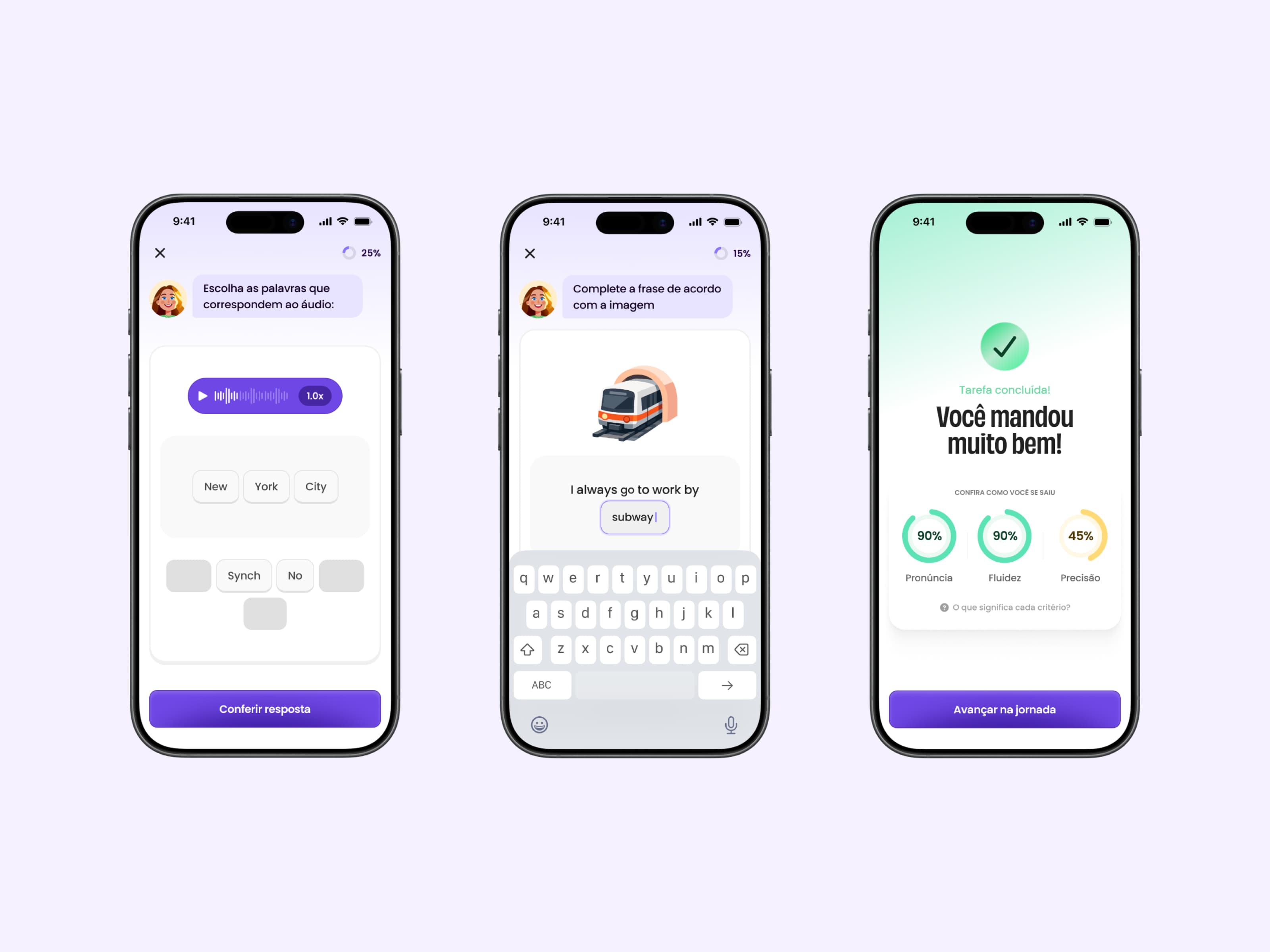
Designing for true beginners: because the target, we couldn't assume any baseline vocabulary. Tasks had to be simple by design, built around cognitive reinforcement and sentence-formation exercises.

The hardest decision in the whole project sat at the intersection of points 1 and 3: pivoting the avatar system from 3D to 2D. The original concept used 3D avatars, but achieving convincing animation and lip-sync at a quality bar we were happy with proved extremely difficult. Moving to 2D flat-design avatars meant reworking the app's visual identity mid-project, a costly pivot, but the right one for the experience to feel polished at launch.
Solution & Results
Fluency App launched on both iOS and Android. As part of a partnership with Familhão, it was also featured on Domingão do Huck, a major Brazilian TV show. The campaign reached a peak simultaneous audience of 13 million viewers. On Google Play alone, the app has passed 10,000+ downloads (comparable public figures aren't available for the App Store).
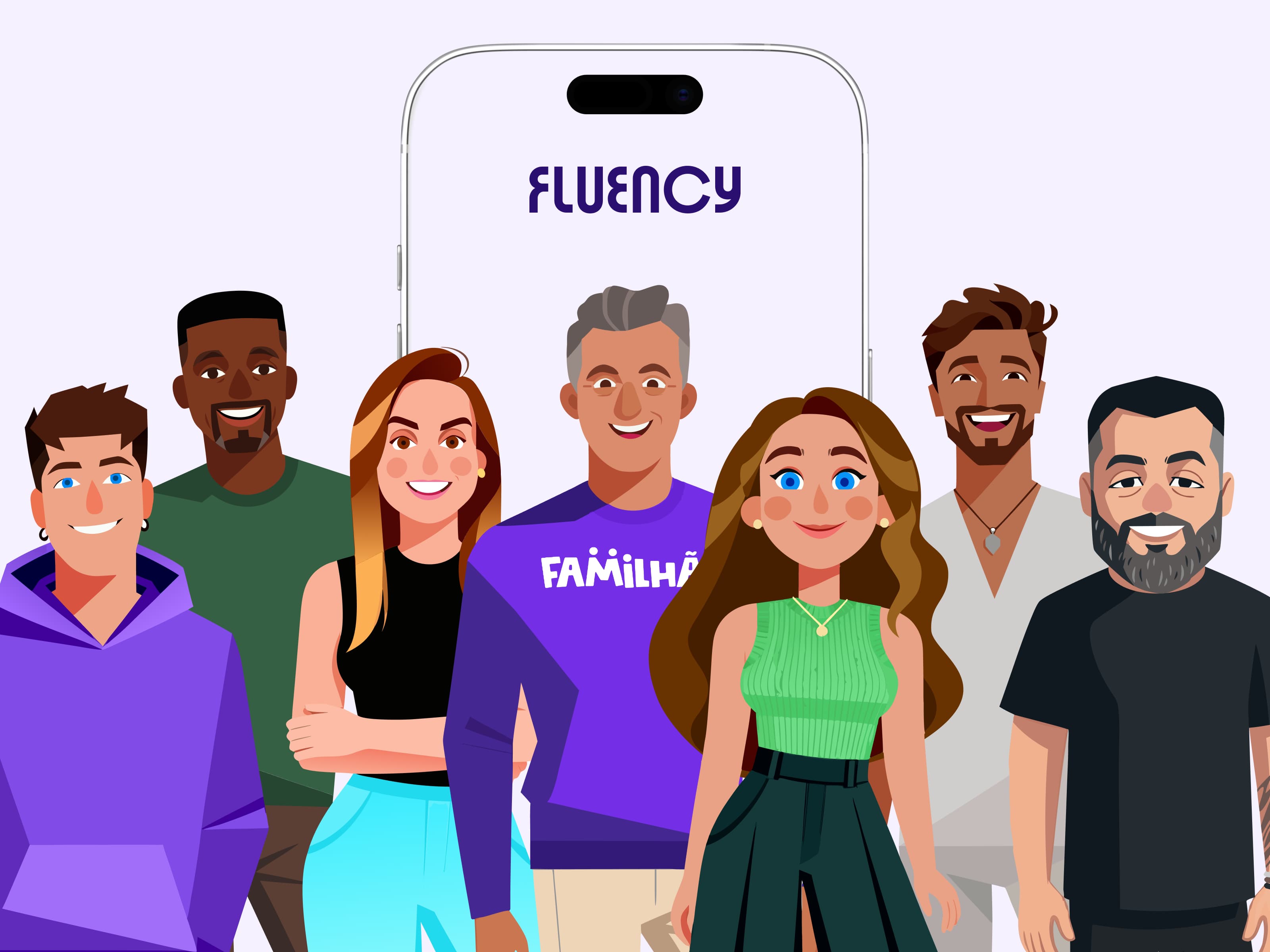
Using influencers as avatar tutors opened the door to work with some of the most influential personas in Brazil, including Luciano Huck (23M IG followers), Paula Gabriela (2.1M), and Igor do Flow Podcast (1M), among others. These creators bring a genuinely emotional relationship with their existing fan base, which made it significantly easier for new users to engage with the app from day zero.

Learnings
The launch was a success, and it came with real lessons attached:
- Working inside a deep AI product environment was a major challenge on its own: architecture, model behavior, and prompt engineering were all steep learning curves.
- The original avatar concept was 3D, but 3D lip-sync and animation proved too hard to get right, so we pivoted to 2D flat-design avatars instead.
- Post-launch, we struggled to track key analytics like DAU and retention, something we had to fix as we went rather than having in place from day one.
- If I did this again, I'd push earlier and more often to share design explorations with stakeholders. A few late-stage presentations of "final" decisions surfaced disagreements and new directions that, if raised sooner, wouldn't have delayed delivery.
- What I'm most proud of isn't the product itself. It's how much I learned about how AI actually works under the hood, going from limited knowledge of the mechanics to real depth by the end of the project.

More case studies