2024 · Product Designer · 1-3 months
Gamers Club Discover - Bringing LATAM's biggest CS community into mobile
tl;dr
- Gamers Club, the largest Counter-Strike community in Latin America, needed to prove mobile could be a real growth vertical for the company.
- I owned the end-to-end design of GC Discover, an app built around a single insight: finding a game is easy, finding people worth playing with is not.
- We shipped alpha and beta versions to the App Store and Google Play in a few months. Before we had enough usage data to validate the direction, a company restructuring reprioritized the projec. The foundation was picked up by another team, reportedly to explore a LATAM publisher distribution hub.
The Problem
Ask any gamer what's harder: finding a new game, or finding people who are actually good to play it with. For most, it's the second one. Matchmaking gets you a team. It doesn't get you your team. People whose skill, schedule, and vibe make the game worth coming back to.
Gamers Club had solved this for PC Counter-Strike. Mobile was untapped. The business goal was direct: grow the user base into a new vertical. But "grow into mobile" isn't a design problem, it's a direction. My job was to turn it into something a designer could actually build against, fast, with the pain point that was already proven on desktop: helping people find others to play with.

My Role
I was the sole product designer on GC Discover, embedded in a small squad with one PM and a dedicated engineering team. I owned design decisions end-to-end — research, flows, UI, and usability testing.

The Approach
1. Narrowing an open mandate under time pressure. The project started late (end of January) with a company-level goal but no defined problem. Instead of running a long discovery phase we didn't have time for, I combined desk research, open surveys, and data from Gamers Club's existing active user base to fast-track toward a scoped problem: helping users discover new games and find people to play them with: the same pain the desktop product had already validated.
2. Choosing speed over certainty. The hardest decision on this project wasn't a UI choice, it was deciding to move forward without enough information to be confident the problem was the right one. With limited research runway, I prioritized shipping something testable over waiting for more data, accepting that risk consciously rather than freezing on an open-ended brief.

3. Testing for both usability and emotional response. We ran two rounds of remote usability testing. The first, using Maze, gave us quantitative signal on flow effectiveness. The second was moderated, using Figma, and focused specifically on how users felt using the discovery and matchmaking flows, not just whether they could complete tasks.
4. Learning to design for a new OS surface. This was my first mobile-native project, which meant absorbing app store publishing requirements, platform-specific gestures, and iOS/Android particularities as part of the design process.
The Solution
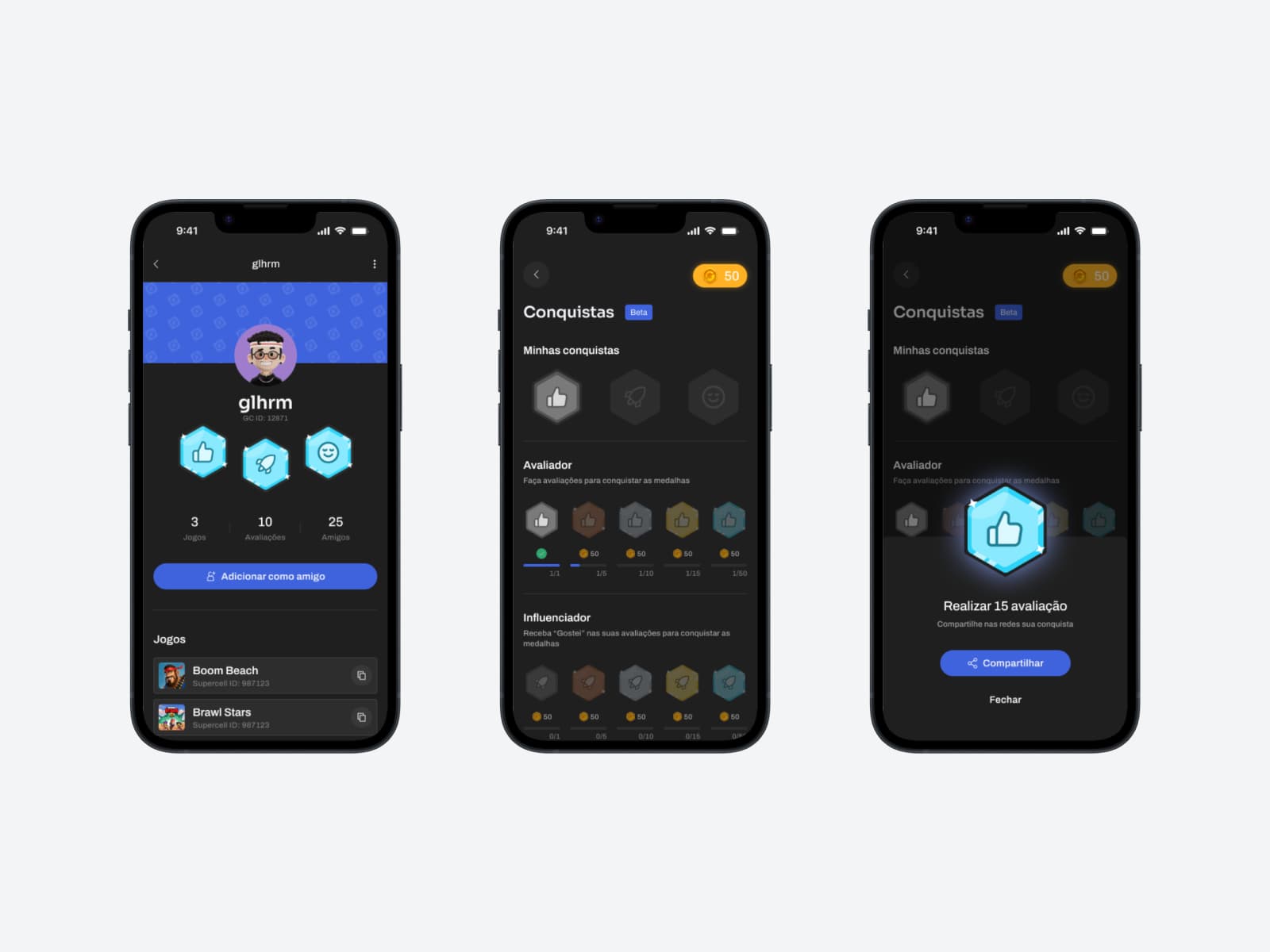
GC Discover shipped to alpha and then closed beta on both app stores, built around two core flows: discovering new games aligned to a player's interests, and finding people to play them with. The same social matchmaking problem Gamers Club had already proven mattered to its community, now rebuilt for a mobile-first experience.

Results & Impact
The project reached closed beta on the App Store and Google Play, but before we accumulated enough usage data to validate the core hypothesis, a company restructuring shifted priorities and the project moved to another team.
What mattered more long-term: the foundation GC Discover built didn't disappear. Leadership at the time pointed toward using it as the base for a LATAM publisher distribution hub, a bigger strategic bet than the original discovery app.
What I Learned
Working with a fully open mandate taught me how to make product decisions under real uncertainty, a very different skill from executing against a validated brief. In hindsight, I'd have pushed harder to interrogate the problem space before committing to a direction, rather than trading exploration time for speed. It's also the project where I learned what "mobile-native" actually means in practice — not just visually, but in how publishing, gestures, and OS conventions shape the product itself.
More case studies